

A healthy social science research ecosystem, I would argue, is characterised by three things: rigour, pluralism and an orientation to impact. This post describes what I mean by each, what goes wrong when one is missing, and how the three criteria interact.
The question of what is required for the social sciences to thrive feels especially pressing at a time when people are questioning the legitimacy of research in some social-science fields, in light of debate occasioned by the Vanderbilt/Washington University report on the State of Scholarship in the Humanities and the Humanistic Social Sciences and other developments.
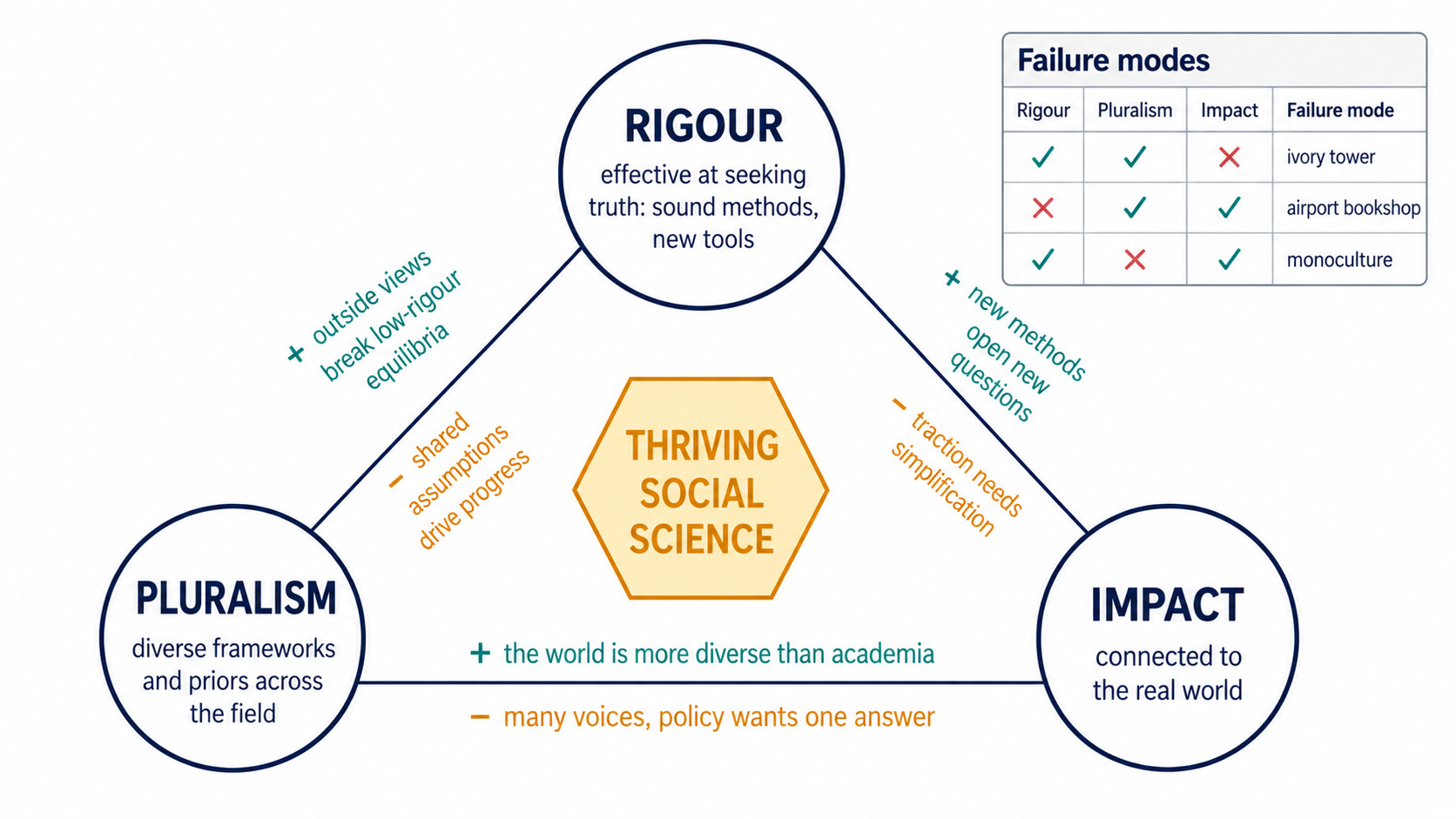
The framework consists of three criteria that must all be sufficiently present for the research ecosystem to be deemed to be thriving: rigour, pluralism, and orientation to impact.
The absence of any of the three leads to distinctive, observable failure modes.
And the three criteria interact with one another in what to me are interesting ways, sometimes reinforcing one another, sometimes in tension.
A couple of caveats: firstly, this framework is meant to describe a field of research, or the social sciences as a whole, rather than a single research project: while some of these characteristics are observable at the level of a project, some only emerge at the level of the broader research endeavour. So it is different from the REF criteria that are used to assess research contributions. Secondly, the framework deals with characteristics of a thriving system, rather than prerequisites (that framework might look very different, and could include things like grant funding, talent, user demand, infrastructure etc).
I’ll define what I mean by each of these criteria, then talk about the relationship between them, and the failure modes that result when they are deficient.
Rigour. How effective the research is in seeking truths. In this framework, ‘rigour’ includes a few different dimensions. There is a static or internal aspect of rigour: is a field of research diligently following its own methodologies - as opposed to falling victim to scientific fraud or methodological error? Then there is a dynamic sort of rigour: is a field adopting and using powerful research technologies, that are effective at gathering evidence and making inferences from it?
Pluralism. A genuine diversity of interpretive frameworks and prior commitments among researchers as a group. Pluralism is valuable for at least two reasons. Firstly, it improves truth-seeking, by reducing the likelihood that important questions go unasked through omission, and by increasing the number of mental toolkits available to address any given question. Secondly, it is pragmatically important in winning public support for research funding, which ultimately relies on the consent of an electorate whose priors may differ from those of social scientists.
‘Viewpoint diversity’ is often considered right-coded in the discourse, since it is used to argue for more conservative political perspectives in academia; however, the same arguments under different names are widely used to support the promotion of researchers with protected characteristics relating to race, sex or sexual orientation, which is left-coded.
It’s sometimes argued that Pluralism is unnecessary if a field is sufficiently oriented towards Rigour, which would imply that Pluralism shouldn’t be a separate criterion. Really good researchers, it is argued, will take into account all necessary perspectives and will be open to new knowledge regardless of its ideological implications. This is perhaps true in theory (perhaps in a world of super-intelligent AI or AI-enabled researchers?), but false in practice. Even very good researchers have to make many choices about what they choose to research, what their priors are, and what methodologies they choose to master, all of which are to a significant extent conditioned by their viewpoint.
Orientation to impact. Research in the social sciences is inherently applied research, in that (a) even the most curiosity-driven social science research generally draws its topics from human behaviour and society, and (b) much social science research has implications for how we live. But the quality of the connection between researchers and the ‘real world’ can vary, both in terms of researchers’ awareness of and connection to the world, and the extent to which research outputs are accessible to lay audiences. This definition of impact includes not just instrumental policy impact, but the impact on public discourse of social research that resonates with public concerns - this includes much work in the critical tradition that might not find its way into a REF Impact case study.
Failure modes
What happens when one of these criteria is lacking?
Deficiencies of rigour accompanied by sufficient pluralism and impact orientation is a familiar situation: consider the non-fiction shelf in the airport bookshop, full of plausible-sounding works on topics of broad interest, based on half-baked or ropey research. It’s also the failure mode where social psychology found itself in the replication crisis of the 2010s.
When impact-orientation is insufficient, we get ivory-tower syndrome. Researchers produce rigorous work for the consumption of other researchers, but it’s of little interest to laypeople and little use to practitioners. The Impact criterion of the Research Excellence Framework clearly creates a strong incentive for researchers to pursue impact, and many of ESRC’s investments shortly after the establishment of UKRI, such as our investments in What Works Centres and the establishment of Administrative Data Research UK in the place of the Administrative Data Research Network were aimed at remedying a perceived failure of impact orientation.
When pluralism fails, the result is groupthink. Failures of pluralism are particularly observable at the system level. As I’ve written elsewhere, rigorous social science can absolutely be motivated by activism and a desire to change the world in accordance with strong ideological priors. But problems arise if these priors are so widely held within a field that bad work gets a pass, or if important questions are neglected because they don’t fit the dominant agenda.
Interactions between the three criteria
The three criteria interact: in some ways, they are mutually reinforcing; in others, they are in tension.
Pluralism can strengthen Impact Orientation, to the extent that the world that social science acts on contains a wider diversity of views and standpoints than exist among social science academics. The two can also sit in tension, to the extent that policymakers and the public are keen to consume ‘settled science’ rather than ambiguity.
Rigour has a complex relationship with Impact Orientation. On the one hand, new methodological approaches can open new avenues of enquiry that are of great practical interest. On the other hand, everyone is familiar with the idea that achieving traction in public discourse or policy debates sometimes requires ideas to be simplified or approximated in ways that are hard to square with the most rigorous research (and sometimes, what practitioners most need is not research at the methodological frontier, but the clear articulation of well established findings that are of limited interest to cutting-edge scholars).
The interaction between Pluralism and Rigour also works both ways. In some cases, rigour is fostered by committed programmes of work in a particular discipline, where scholars share foundational assumptions and can focus on advancing the knowledge frontier. Sometimes marginal perspectives or heterodox approaches are in fact marginal because they have been shown to be not very useful or even wrong. To put it another way, disciplinary specialisation can be seen as an example of viewpoint homogeneity - but sometimes, it is useful.
At the same time, disciplines can become stuck in low-rigour equilibria, where methodologically unsophisticated work is praised and cited. Sometimes this is related to ideological groupthink within a discipline, where ideological homogeneity provides cover for unconvincing analysis. In these cases, exposure to other perspectives, perhaps methodological or perhaps ideological, can improve Rigour.
The usefulness of this framework
All frameworks are to some extent arbitrary: the measure of a good framework is what it can be used for. The reason I tentatively think this framework is useful is: (a) it sets out a structure of criteria for how ESRC can judge the effectiveness of its funding interventions; (b) it provides a way of thinking about the relationship of three criteria that are often talked about separately in the context of research policy.
A few initial reflections on how ESRC funding has performed in the context of this framework:
When it comes to Rigour, we have largely relied on the peer- and panel-review process of our Responsive Mode of research funding (henceforth Applicant-Led Mode) to deliver rigorous work and disciplinary health. Our main tool for judging its success is the REF; we collect little scientometric information about the outputs of past grants, and currently have no systematic process for reviewing it in any case, though this is changing with our establishment of a new analytic capability and the work of the UK Metascience Unit, which we host. We have made relatively little use of Centres for Doctoral Training, which are a potential way of focusing doctoral funding on new methodologies or promising sub-fields.
Impact has been a significant focus of ESRC’s Targeted Mode investments (a stream of funding that has now ended, but which historically accounted for the bulk of ESRC managerial effort when it comes to commissioning research), and continues in the new UKRI strategy through our investment in “Bucket 2”, which invests in applied research aimed at government and social priorities. It is widely thought that ESRC is much better at funding to achieve impact than it used to be. On the other hand, measuring impact is difficult, and it is not clear what our standard of impact should be and how many of our projects meet this standard.
Pluralism has not been a significant focus of how we think about the portfolio of ESRC funding activity, except for a relatively small set of grants relating to EDI. We currently have no systemic way of assessing pluralism in fields we fund or of considering pluralism in funding processes, nor does the way we publish our funding information make it easy to form an external perspective of this I am interested in ways that we might address this.
Great framework.
I am unsure whether what is effectively a sole reliance on peer review and panels is a sufficient defence of rigour in cases where entire disciplines become suspect - I am thinking, perhaps, of education research. Perhaps interdisciplinary scrutiny could play a role. Would top academics in economics, biology or law accept 'autoethnography' or small case studies - detached from examination of what is really happening in real-world schools - as sufficiently rigorous? It could be worth a try.
A problem with this analysis is that while it addresses the problems of too little pluralism, rigour or impact, the actual problems in the field may be related to *too much* of the above. For instance: 1. You find people so completely wrapped up in their desire to "make a difference" that they never notice that the means they are using are unethical. 2. At what point do you decide that you can no longer withhold treatment to the placebo arm of your medical trial? Or must you continue as your trial was designed for the sake of rigour in the result? 3. When does "listening to other people's perspectives" become "letting anybody who wants a piece of your funding manufacture a narrative and a grievance that undermines what you are trying to do?". These matters are all in the realm of how to cultivate and exercise good professional judgement. And a large part of the troubles we find ourselves with is because we mistakenly thought we could replace good judgement with a compliance document and "proper procedures".